
By Ann Fisher-Jackson | Chief Strategist
There are two versions of every federal funding cut. The one that gets covered, and the one that lands.
The covered version happens in Washington. It has a number, a bill name, a roll call, and a margin. It gets analyzed in two news cycles, debated for one more, and then absorbed into the next political story.
The version that lands does not have a number. It has a single mother in North St. Louis County whose Medicaid renewal notice arrives in a language she does not read fluently. It has a nonprofit director in Joplin opening her email at 6:47 a.m. to find the third “pending review” notice this quarter on a grant her organization built its staffing plan around. It has a regional food bank in Springfield where SNAP-eligible visits have doubled in three months while their warehouse contracts stay flat.
That second version, the one that actually lands, is the story almost no one is telling.
The cut is not an event. It is a process that starts in Washington and never finishes anywhere.
National coverage has settled into a familiar shape. Federal cuts get framed as a Washington fight: who voted what, what passed, what got blocked, who wins the political news cycle. In Missouri, state coverage usually mirrors it. The cut is treated as an event with a date attached.
It moves through a state agency that loses staff. It moves through nonprofits that absorb new responsibilities. It moves through foundations asked to stretch limited resources further. And it keeps moving, compounding, long after the original headline has gone quiet.
If you want to see what federal funding volatility actually does, you have to look at the region. The region is where the cut lands. The region is where the response is being built. And the region is where the truest version of this story is hiding in plain sight.
The visible cut is a fraction of the damage
When a federal program loses funding, the public number describes one thing: how much money will not flow. It does not describe what happens when the money does flow but arrives late, conditioned, restructured, or paired with new reporting that consumes a third of a small agency’s staff time. It does not describe what happens when people stop trying to apply because the burden of applying has become the real barrier. It does not describe what happens to the other things a nonprofit was doing before it became the de facto navigator for a federal program no one is staffing anymore.
Three forces compound underneath the topline number.
The first is the administrative burden. Every policy shift creates work. Every error creates rework. Every uncertainty creates hesitation. The result is a quiet but punishing tax on every organization, family, and worker in the system. Administrative burden is not a side issue. In a permanent volatility environment, it becomes the dominant mechanism of harm.
The second is indirect impact. A delay in reimbursement creates a cash flow crisis. A cash flow crisis triggers staffing decisions. Staffing decisions disrupt service delivery. Service delivery disruptions push the need into adjacent organizations that were already at capacity. By the time anyone counts what was lost, the original cut has become a network event.
The third is absorbed systemic failure. Nonprofits in this country were never designed to be the operating system for essential services. They were designed to complement that system. We have not had a serious public conversation about the fact that they are now being asked to be the system, with none of the funding stability, hiring authority, or legal infrastructure that role requires.
These three forces do not add. They multiply.
In Missouri, the topline numbers are sobering on their own. The compounding underneath them is what will actually reshape the region.
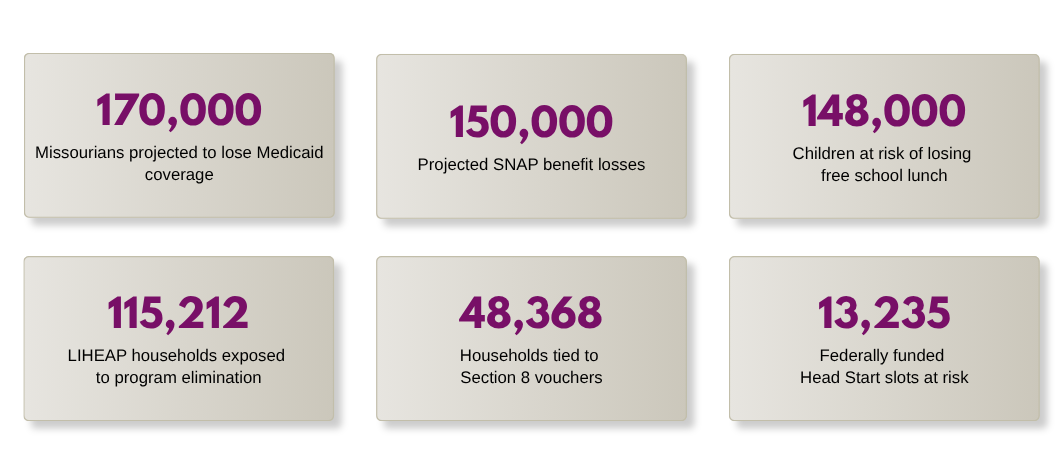
This is not a moment. It is a system.
The other piece of the story being missed is the temporal one.
We are still writing about federal volatility as if it were a singular event with a beginning and an end. A bill passes. A program is paused. A waiver expires. A negotiation resumes. The framing assumes that on the other side of the disruption, the system stabilizes.
It does not. The disruption is the system now.
What makes this moment different is not any single policy change. It is the convergence of multiple pressures operating simultaneously. Federal funding cuts. Administrative retrenchment. Rising healthcare costs. Workforce instability. Housing affordability challenges. Environmental disasters. Each would be significant on its own. Together, they create a level of uncertainty that few public, nonprofit, or philanthropic systems were designed to absorb.
Permanent volatility is not a slogan. It is the operating condition.
Federal funding shifts, benefit disruptions, workforce instability, housing pressures, and environmental disasters are increasingly occurring simultaneously and reinforcing one another.
Most of the systems we rely on were built for a more predictable environment. Annual grant cycles, multi-year strategic plans, project-based philanthropy, and long reporting horizons all assume a degree of stability that no longer exists.
That assumption is now broken. The response infrastructure is still operating as if it were not.
If the pressure is compounding locally, the response must be organized locally as well. The impacts do not arrive neatly separated by issue area or funding stream. Families experience them all at once. Nonprofits absorb them all at once. The institutions trying to respond need a level of coordination that neither Washington nor individual organizations can provide on their own.
The unit of response is regional.
Here is what becomes obvious when you spend time inside this work: the federal level is where the cut originates, but it is not where the response can be coordinated. Washington is not going to coordinate the response. State governments are stretched and, in many cases, structurally unable to play this role. National philanthropy is making important moves, but it is not where day-to-day coordination happens.
The extent to which a response can be coordinated at the speed and granularity this moment requires is regional.
Regions are small enough that the actors know each other. They are large enough to span sectors, jurisdictions, and program areas. They contain the philanthropic capital, civic infrastructure, nonprofit networks, and data systems necessary to see what is happening and act on it. They are where the people who absorb the cuts and the people who can deploy resources actually exist within reach of one another.
In Missouri, that has meant a small group of philanthropic leaders, anchored by the St. Louis Community Foundation alongside the James S. McDonnell Foundation, Missouri Foundation for Health, and Dana Brown Charitable Foundation, who decided not to wait for someone else to make sense of what was coming. The work is happening because they chose to build the scaffolding regionally, before the next event hits. Thirty-nine federal programs were reviewed. Five deep dives. Stakeholder interviews. A vulnerability scoring framework. A common framework civic and nonprofit leaders can actually use.
None of that exists because Washington decided to coordinate. It exists because a region decided to.
What philanthropy is actually being asked to do
This is the part of the conversation that has been the quietest, and the part that needs to get loud.
Philanthropy in this country has spent most of the last several decades positioning itself as a complement to public investment. Innovation funder. Catalytic capital. Bridge financing. Demonstration grants. The premise underneath all of it was that government would do the heavy lifting on essential services, and philanthropy would push at the edges.
That premise is no longer operative in many regions. In housing assistance, energy assistance, child nutrition, early education, and basic health coverage, the federal scaffolding that philanthropy was complementing is now itself uncertain. The nonprofit’s philanthropy funds are absorbing functions that public systems used to handle. The math has changed under everyone’s feet.
A safety net catches what falls through. Infrastructure is what people stand on.
What that means is that philanthropy is being asked, whether it wants to be or not, to function as infrastructure. Not a safety net. Infrastructure. This does not mean philanthropy can replace public investment. It means philanthropy may be one of the few actors positioned to stabilize systems while public policy remains volatile.
Standing infrastructure requires different things from a safety net. It requires speed. It requires lower-burden grantmaking because the organizations on the receiving end no longer have the slack to absorb application processes designed for stable times. It requires stabilization funding, not just innovation funding. It requires technical assistance and navigation capacity. It requires coordination across foundations rather than portfolio competition. It requires a willingness to say, openly, that the role has changed and to act accordingly.
Most philanthropic institutions know some of this. Very few have rewired their posture to match it.
What changes when you take the regional story seriously
If the unit of response is regional, several things follow that have not yet become common practice.
Funders in the same region need to know what each other is funding, on a faster cadence than annual reporting allows. Not coordination as a virtue. Coordination is a basic requirement when the operating environment is shifting weekly.
Nonprofits need to be funded for what they are actually doing now, including the work they were not designed to do but have had to absorb. If an organization is navigating, translating, advocating, and replacing public functions in addition to its original mission, its funding model must reflect that, or it will collapse.
The story has to be shared. One of the quiet failures of the last several years is that regional civic systems have lacked a common narrative they can use across organizations. Small nonprofits do not have comms teams. They cannot build the story on their own. The region has to build the story together and make it available, in plain language, for anyone who needs to use it.
And the work has to be ongoing. Thinking that produces a scan or a report and stops there will not survive the next round of volatility. What is needed is a regional capacity to continue the analysis, keep updating priorities, and allocate resources in response.
The truer story
There is a story being told about federal funding right now. It is a story of cuts, fights, numbers, and political theater. It is the story Washington produces about itself.
There is a truer story being lived in regions. It is a story about communities adapting to an environment that no longer behaves predictably. About institutions absorbing responsibilities they were never designed to carry. About local leaders building new forms of coordination while the pressures continue to shift beneath them. And about the people in St. Louis, Springfield, Joplin, Kansas City, and a hundred small Missouri towns whose lives are shaped by decisions made somewhere else but absorbed close to home.
That story is the one that explains what is actually happening. It is the one philanthropy, civic leadership, and policy audiences need to hear. And it is the one that, for the moment, almost no one is telling.
We are going to keep telling it.
Ann Fisher-Jackson is Chief Strategist at Key Strategic Group, where she participated on the team working on the Missouri Federal Funding Project in partnership with the St. Louis Community Foundation, James S. McDonnell Foundation, Missouri Foundation for Health, Dana Brown Charitable Foundation, and the Center for Civic Research & Innovation.