By Rebecca Weaver, Community Impact Strategist
Ask someone to name a city’s infrastructure, and they’ll likely mention roads, bridges, water lines, transit systems, or broadband. These are the systems we plan for, invest in, and maintain because they make modern daily life possible.
Nature rarely makes that list. We tend to think of trees, parks, rivers, and wetlands as scenery, amenities, or luxuries rather than essential public systems. Roads and pipes show up in capital budgets and maintenance plans, while a stand of mature oak trees usually doesn’t, even though it cools neighborhoods, filters the air, stabilizes soil, and provides habitat every day.
That framing misses something important. Forests, rivers, wetlands, and grasslands have value independent of what they do for us, as the ecological foundation that every economy, institution, and civilization ultimately depends on. These ecosystem services are worth trillions of dollars by some estimates, but they are intrinsically worth far more than any estimate can capture (World Bank, 2021).
Recognizing that value doesn’t diminish the importance of roads, utilities, or transit. It’s a reminder that none of those systems exist apart from the ecological ones that sustain them: healthy watersheds provide our drinking water, healthy soils produce our food, and wetlands buffer our communities from floods and storms.
For planners, public agencies, and community leaders, that means expanding how we define infrastructure. Infrastructure is defined by the essential functions it performs for society, not simply by the materials it is made from. By that standard, nature is more than ecological infrastructure; it is civic infrastructure, too. Parks, greenways, tree-lined streets, and community gardens shape how people move through their neighborhoods, encounter one another, and develop a sense of belonging.
That’s not a claim that nature exists for us, so much as a recognition that we can’t build healthy, connected communities without it. After all, we humans are nature.
The rest of this piece considers what that shift asks of us—and how the way we plan, invest, and govern might change once we treat nature as infrastructure rather than scenery.
Nature Shapes How We Move Through a Place
Once nature counts as civic infrastructure, the question changes. It’s no longer whether parks, trees, and wetlands provide benefits, since they clearly do, but whether we plan for and steward them with the same intention we bring to roads and water lines.
The same tree canopy that cools a street also makes it more comfortable to walk, and the same greenway that absorbs stormwater also allows neighbors an opportunity to meet. Ecological and civic benefits aren’t separate outcomes; they reinforce each other, but only when nature is close enough to reach.
A park that requires a car ride and a highway crossing isn’t really part of a neighborhood’s civic fabric, even if it’s only a mile away, because nature can’t foster connection, health, or belonging if it sits outside the routines of daily life.
That’s what makes Reid Ewing and Robert Cervero’s research on the subject so useful: their years of studying how physical design shapes travel found what most people already sense, that when neighborhoods are built at a human scale, with connected streets and everyday destinations within walking distance, people walk more, drive less, and engage more with the place around them (Ewing & Cervero, 2010). That finding is really a planning mandate. A greenway connecting homes to schools, grocery stores, and transit stops does more work than a road ever could, moving people while it also cools neighborhoods, manages stormwater, and creates space for community life, all in the same right-of-way. Treating it as an amenity undercounts what it actually does, and underfunds it accordingly.
Weaving nature into the everyday paths of community life isn’t adding something extra. It’s restoring a living foundation that has always made human settlement possible, which means treating trails and tree canopy with the same seriousness we give pavement.
Nature Is Social Infrastructure
If nature shapes how we move through a community, it also shapes who we run into along the way, which is easy to overlook and may be one of the more important things civic infrastructure does.
In Bowling Alone, political scientist Robert Putnam argued that American civic life was weakening as social capital, the trust and informal networks that let communities function, eroded (Putnam, 2000). More than two decades later, the U.S. Surgeon General reached a similar conclusion from a different direction, calling loneliness and social isolation a public health crisis linked to a higher risk of heart disease, depression, dementia, and early death (U.S. Surgeon General, 2023). The common thread in both: communities need places where people run into each other as neighbors, not strangers.
Nature can’t fix loneliness on its own, but it can create the physical conditions that make repeated, informal contact possible: a bench where the same people end up at the same time, a trail neighbors both walk, a garden that needs tending. That’s a more modest claim, and it’s also the more accurate one, since it’s what separates nature as civic infrastructure from nature as a nice place to sit. Infrastructure doesn’t guarantee an outcome. It makes an outcome possible, again and again, until it becomes ordinary.
The research backs this up. Neighborhoods with accessible parks and natural areas report stronger social cohesion and trust, largely because those spaces give people a simple, recurring reason to be in the same place (Jennings & Bamkole, 2019), and the Project for Public Spaces has reached a similar conclusion after decades of studying successful public places: people return when a space is comfortable, welcoming, and gives them a reason to linger (Project for Public Spaces, 2018).
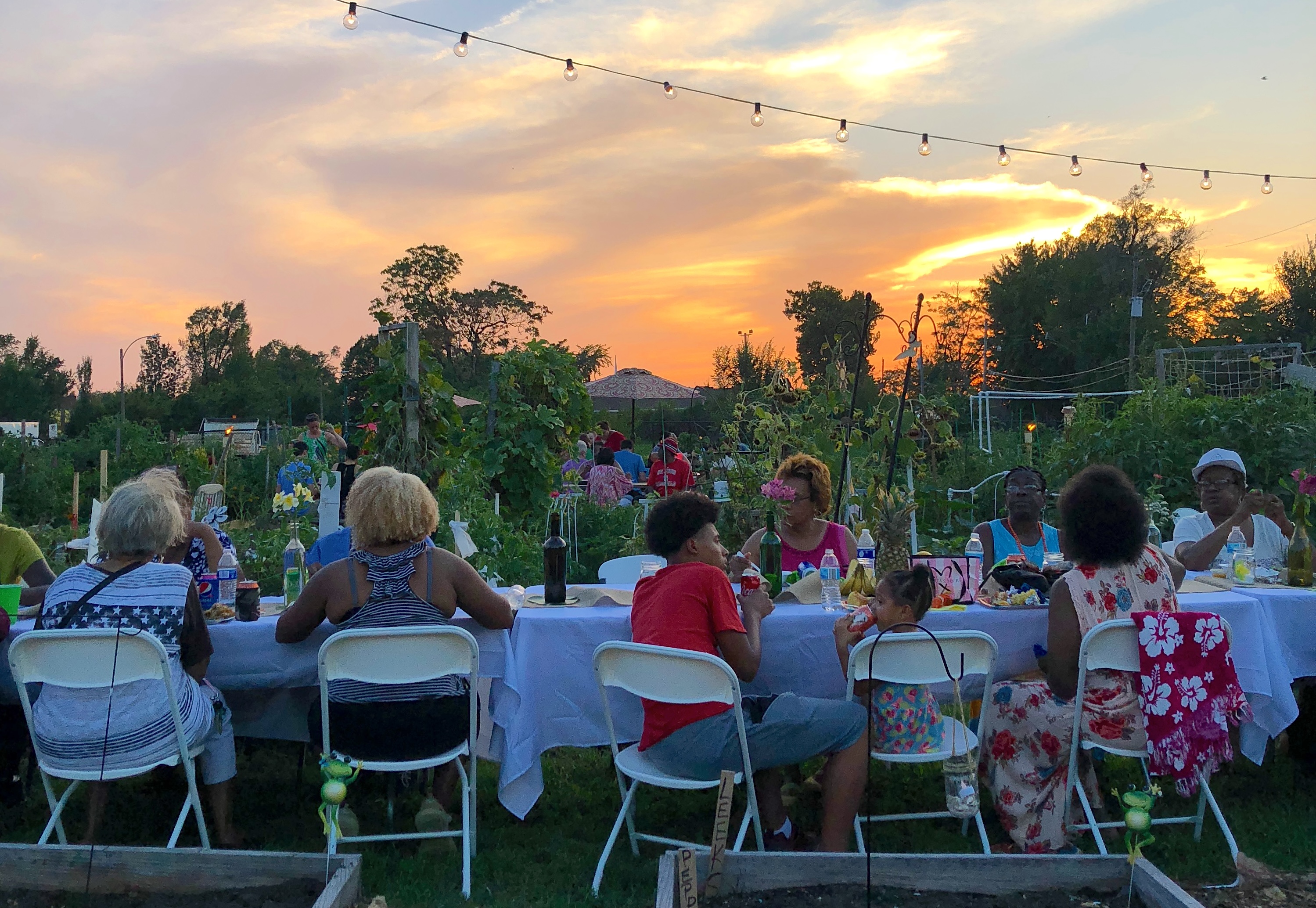
A parent chatting with another parent at a playground. Neighbors greeting each other on a shaded trail. Volunteers tending a community garden. None of these moments look significant on their own, but repeated over years, they’re what civic trust is made of, which is why a park is more than open space and a greenway is more than a trail. They’re the physical preconditions for relationships to form and communities to organize, exactly what infrastructure is supposed to do.
Investing in Nature Is Also an Investment in Equity
Like every form of infrastructure, access to nature has never been distributed equally, and that’s no accident. Neighborhoods that have experienced decades of disinvestment tend to have fewer trees, more pavement, hotter summers, and less access to quality parks, patterns that trace back to segregation, redlining, and unequal public investment and still shape health and environmental quality today (Locke et al., 2021; Trust for Public Land, 2026a; World Resources Institute, 2020).
Once nature counts as infrastructure, that gap stops being only an environmental problem and becomes an investment problem. Every infrastructure decision- a road, a sewer line, a park- answers the same underlying question: who gets the investment, who benefits from it, and who ends up owning the result. Nature has been left out of that accounting for so long that most communities have never gotten to ask it.
Asking it changes how projects get built, not just where. Too often, parks and green infrastructure projects start with a predetermined design rather than a real conversation about what a community actually wants, and the result might be beautiful without being something people feel is theirs.
This is where community engagement stops being a required step and starts being part of the infrastructure itself. When residents help shape a park, greenway, or streetscape, they aren’t just giving feedback on a design. They’re building the trust and working relationships that let a community act together on the next project, and the one after that. That civic capacity, the ability of neighbors to organize, negotiate, and follow through together, is as much a public asset as the park itself, and it’s the part that’s hardest to rebuild once it’s gone.
Communities that feel ownership over a shared space maintain it, defend it, and build on it, which shows up in avoided stormwater costs and stronger local economies as much as it does in how a park looks ten years on (Trust for Public Land, 2026b). Infrastructure succeeds not only because it’s built well, but because people believe it belongs to them.
Planning for Living Systems
If nature is civic infrastructure, the question isn’t whether parks and trees provide value. It’s what changes in how we plan, fund, and govern.
Instead of asking where we can fit another park, ask whether children can safely walk to school, whether residents have access to nature in their daily routines, and where neighbors actually gather. Those questions belong in capital planning and maintenance budgets, not just parks master plans, and they should shape how transportation departments design streets, how development review evaluates a new subdivision, and how a city decides what gets funded first when money is tight.
That kind of planning breaks down the silos that have shaped how communities get built. Treating nature as a parks and environment issue, separate from transportation, public health, and economic development, is exactly what has kept it out of capital budgets for so long, even though parks departments, transportation planners, public health agencies, and residents are already working on the same underlying problems. They just rarely work on them together, or fund them together, despite how deeply interconnected those challenges actually are: climate change, biodiversity loss, social isolation, aging infrastructure (IPBES, 2019; U.S. Surgeon General, 2023). A planning process that keeps treating them separately will keep producing solutions that don’t add up to much.
This isn’t just a framing problem. It shows up directly in how cities budget. Most park and urban forestry programs are still funded as discretionary line items that compete for money every budget cycle, the same way a marketing campaign might, rather than as core infrastructure with a dedicated revenue stream the way water and sewer systems are. New York City’s own comptroller has drawn that distinction explicitly, noting that some cities fund parks like a public utility while New York has historically treated its park system as a discretionary agency asking for money each year (New York City Comptroller, 2026). The gap that opens up is real: cities spend about $154 per resident on parks in an average year, but the best-funded systems spend more than double that, largely because they treat that funding as stable rather than something to be re-justified annually (Trust for Public Land, 2026a).
A handful of cities are already closing that gap, and they’re doing it with the same financing tools cities already use for roads and utilities. Claremont, California funds its urban forestry program through a standing assessment on residential properties. Jacksonville built a tree mitigation trust that now covers most of its tree maintenance budget. Other cities have started directing a share of stormwater fees toward tree canopy, since a mature tree does measurable stormwater work of its own (PlanIT Geo, 2023). None of this is a new idea. It’s the ordinary machinery of infrastructure finance, aimed at nature instead of asphalt.
Ultimately, expanding our definition of infrastructure is an act of remembering.
Long before roads, pipes, and power lines, healthy forests, rivers, wetlands, and grasslands made human settlement possible. Human communities have never existed apart from nature. We’ve simply grown accustomed to planning as though they do.
Treating nature as optional isn’t just an environmental mistake. It’s a failure to understand what makes a community work in the first place.
If we want healthier, more connected, more resilient places, we have to recognize that the health of our communities has always been inseparable from the health of the living systems around them. We then have to put that recognition into our budgets, our plans, and what we choose to build.
Rebecca Weaver is a Community Impact Strategist at Key Strategic Group, where she has worked with partners including Bezos Earth Fund, Great Rivers Greenway, the Community Builders Network, and the City of St. Louis’ Zoning Upgrade (ZOUP) Project. Her work focuses on strategic planning, civic engagement, and advancing equitable, resilient communities through cross-sector collaboration.
References
Ewing, R., & Cervero, R. (2010). Travel and the Built Environment. Journal of the American Planning Association, 76(3), 265–294. https://doi.org/10.1080/01944361003766766
Intergovernmental Science-Policy Platform on Biodiversity and Ecosystem Services (IPBES). (2019). Global Assessment Report on Biodiversity and Ecosystem Services.
Jennings, V., & Bamkole, O. (2019). The relationship between social cohesion and urban green space: An avenue for health promotion. International Journal of Environmental Research and Public Health, 16(3), 452. https://doi.org/10.3390/ijerph16030452
Locke, D. H., Hall, B., Grove, J. M., et al. (2021). Residential housing segregation and urban tree canopy in 37 U.S. cities. npj Urban Sustainability, 1, 15. https://doi.org/10.1038/s42949-021-00022-0
New York City Comptroller (Levine, M.). (2026). New York City’s Living Infrastructure: Funding and Managing NYC’s Urban Forest and Tree Canopy. Office of the New York City Comptroller.
PlanIT Geo. (2023). The Ultimate Guide to Urban Forestry Funding.
Project for Public Spaces. (2018). What Makes a Successful Place?
Putnam, R. D. (2000). Bowling Alone: The Collapse and Revival of American Community. Simon & Schuster.
Trust for Public Land. (2026a). ParkScore® Index.
Trust for Public Land. (2026b). The Undeniable ROI of Community Parks and Green Spaces.
U.S. Surgeon General. (2023). Our Epidemic of Loneliness and Isolation: The U.S. Surgeon General’s Advisory on the Healing Effects of Social Connection and Community.
World Bank. (2021). The Economic Case for Nature.
World Resources Institute. (2020). Toward a More Equal City: Nature-Based Solutions for Urban Equity.